
September 23, 2026
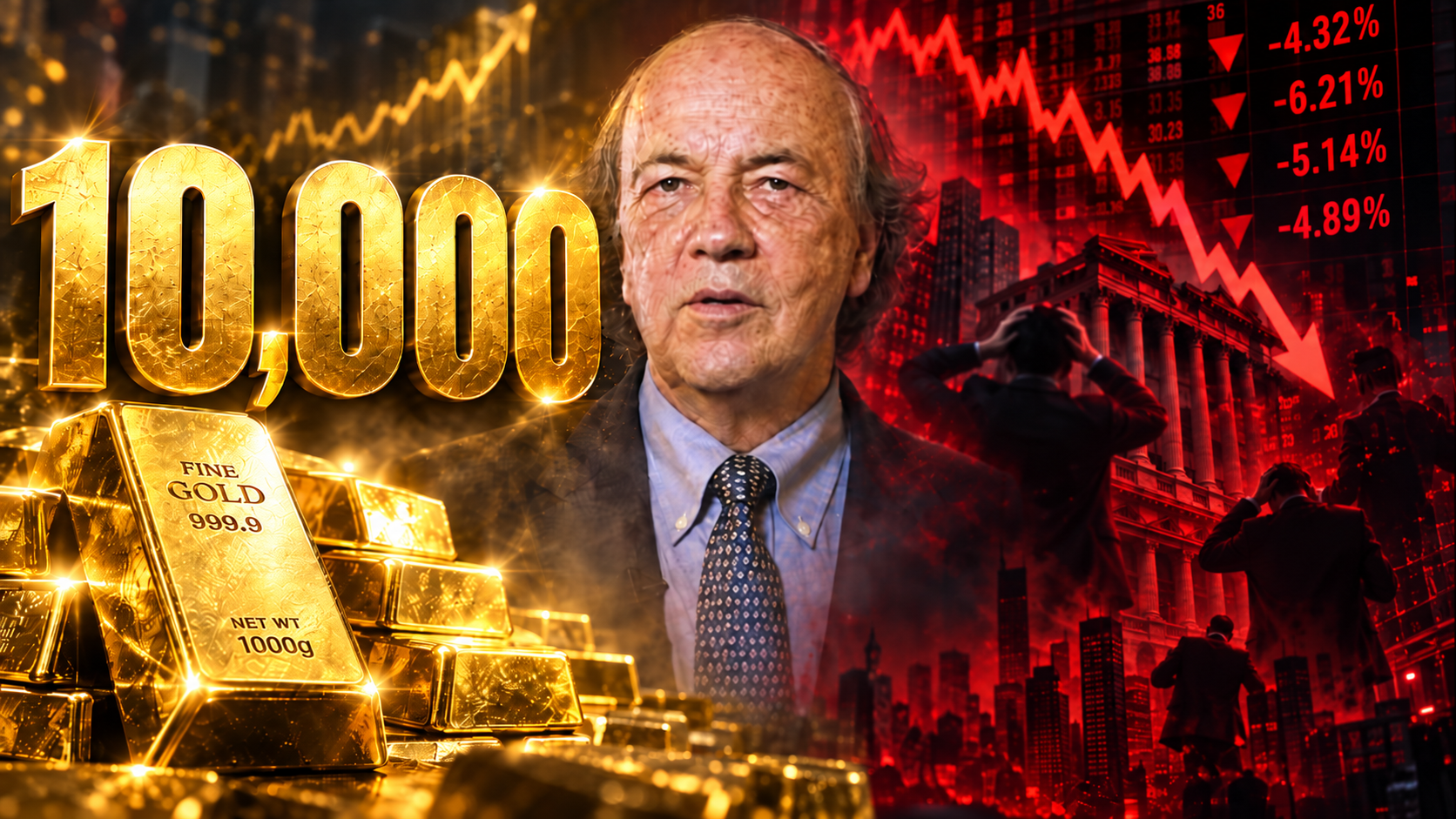
Gold has already experienced one of the most dramatic periods in its modern history. Now, author and macroeconomic commentator Jim Rickards is maintaining an even more aggressive forecast: gold could reach $10,000 per ounce by late 2026 or sometime in 2027.
Rickards has argued that the move could occur much faster than many investors expect. In recent commentary, he said that even if the target is not reached before the end of 2026, a move into early or mid-2027 would remain consistent with his broader thesis.
That would represent an extraordinary repricing.
As of September 23, spot gold was trading near $4,283 per ounce, after falling more than 1% as expectations for additional Federal Reserve rate increases strengthened the U.S. dollar.
For gold to reach $10,000 from approximately that level, the metal would need to rise roughly 134%.
So what could possibly drive a move of that magnitude?
Rickards’ $10,000 Gold Forecast
Rickards’ argument is not based on the assumption that gold simply continues rising at its recent pace.
Instead, his thesis centers on the possibility that several structural forces could converge at the same time: continued central-bank accumulation, diversification of global reserves, persistent inflationary pressure, monetary instability, geopolitical uncertainty and limited growth in global gold production.
Rickards has also used historical gold cycles and what he describes as fractal or scale-invariant market behavior to support his long-term price expectations.
Whether that framework ultimately proves correct remains unknown.
But several of the underlying trends Rickards points to are measurable today.
Central Banks Continue Buying Gold
Perhaps the strongest fundamental argument behind the bullish gold thesis is central-bank demand.
According to the World Gold Council, central banks purchased a net 289 tonnes of gold during the second quarter of 2026.
That represented a major rebound from the first quarter.
Central-bank buying has also changed significantly on a longer-term basis. The World Gold Council reports that central banks accumulated an average of approximately 1,000 tonnes of gold annually over the last four years, compared with roughly 500 tonnes annually during the preceding decade.
That represents a major structural change in demand.
And reserve managers appear to expect the trend to continue.
In the World Gold Council’s 2026 Central Bank Gold Reserves Survey:
89% of surveyed reserve managers expected global central-bank gold reserves to increase over the following 12 months.
A record 45% said they expected their own institution to increase its gold reserves.
That does not guarantee higher gold prices. Central banks can slow their purchases, and some institutions periodically sell gold.
In fact, while second-quarter buying accelerated significantly, total central-bank demand during the first half of 2026 was the lowest first-half total since 2022.
The larger trend, however, continues to show significant official-sector interest in gold.
A Gradual Shift in Global Reserves
Rickards also points toward diversification away from excessive dependence on dollar-denominated reserves.
The World Gold Council’s 2026 survey provides evidence that reserve managers are considering exactly that issue.
Roughly 74% of respondents expected the U.S. dollar’s share of total global reserves to be lower five years from now.
That does not mean central banks are abandoning the dollar.
The U.S. dollar remains a central component of the international monetary system.
But even modest diversification across hundreds of billions or trillions of dollars in global reserves can create substantial demand for alternative reserve assets.
Gold occupies a unique position in that discussion because it is not the liability of a corporation, commercial bank or sovereign issuer.
Gold Is Still Fighting Higher Interest Rates
The bullish case is not without major obstacles.
On September 23, gold fell to approximately $4,283 per ounce as markets reacted to expectations for additional Federal Reserve tightening.
Higher interest rates can work against gold because gold does not pay interest.
When investors can earn attractive yields from Treasury securities and other fixed-income assets, the opportunity cost of holding non-yielding bullion increases.
A stronger U.S. dollar can create another headwind because gold is generally priced in dollars internationally.
That dynamic has been visible throughout 2026.
Gold reached substantially higher levels earlier in the year before experiencing a significant correction.
That volatility is an important reminder that even a long-term bullish market can experience sharp declines.
Inflation and Monetary Policy Remain Critical
The next phase of the gold market may ultimately depend on how policymakers manage inflation, interest rates and economic growth.
Persistent inflation could increase demand for assets viewed as stores of value.
At the same time, central banks may respond to inflation by maintaining higher interest rates, which can pressure gold.
That creates an unusual environment.
Inflation can strengthen one part of the argument for owning gold while the monetary-policy response to inflation can simultaneously work against the metal.
The balance between those forces could become one of the most important variables for gold heading into 2027.
Gold Supply Cannot Expand Overnight
Another component of the bullish argument is supply.
Gold production cannot rapidly respond to higher prices in the way production can increase in some other industries.
Discovering a viable deposit, permitting a mine, obtaining financing and ultimately producing gold can take many years.
That means a sudden increase in investment or central-bank demand cannot necessarily be met by a comparable short-term increase in newly mined supply.
This does not automatically produce $10,000 gold.
But constrained supply can amplify price movements when demand rises sharply.
What Would $10,000 Gold Actually Mean?
A $10,000 gold price would likely require much more than ordinary investment demand.
It could involve some combination of:
- Significantly stronger central-bank accumulation
- Increased investment demand for physical gold and gold-backed assets
- Continued reserve diversification
- Persistent inflation concerns
- Falling confidence in conventional financial assets or currencies
- Major geopolitical or financial-market stress
- Lower real interest rates
- A weaker U.S. dollar
- Tight physical gold supply
Several of those forces could occur simultaneously.
Others could move in the opposite direction.
For example, persistently high real interest rates, a strong dollar, reduced central-bank demand or improving geopolitical conditions could limit gold’s upside.
Does Gold Need to Reach $10,000 for the Investment Case to Matter?
Probably the more practical question for investors is not whether one specific forecast proves exactly correct.
It is whether the structural forces driving demand for gold are changing.
Central banks are continuing to hold and accumulate substantial quantities of gold. Reserve managers are openly discussing diversification. Investors are navigating inflation, high interest rates, large sovereign debt markets and geopolitical uncertainty.
Those conditions have contributed to a renewed discussion about the role physical precious metals can play inside a diversified portfolio.
Gold can also decline substantially, does not generate interest or dividends and can remain volatile for extended periods.
No price forecast—including a $10,000 target—is guaranteed.
The Bottom Line
Jim Rickards’ forecast of $10,000 gold by late 2026 or 2027 is unquestionably aggressive.
With gold near $4,300 as of September 23, reaching that target would require another historic move higher.
But the forecast is attracting attention because several of the forces behind Rickards’ thesis are already visible: central banks remain significant gold buyers, reserve diversification is continuing, global monetary conditions remain uncertain and physical gold supply cannot be rapidly expanded.
Whether those forces are powerful enough to send gold to $10,000 is something the market will ultimately determine.
For investors, the more important consideration may be understanding why gold is playing an increasingly prominent role in discussions about reserves, inflation protection and portfolio diversification.
Limitless Metals helps investors learn about physical gold and silver, direct-delivery precious metals and precious metals IRAs.
This article is provided for informational and educational purposes only and should not be considered investment, tax or legal advice. Precious metals prices can rise or fall, and past performance does not guarantee future results.
Sources
Canadian Mining Report — “Jim Rickards Sees $10,000 Gold by 2027: What Could Drive the Next Major Rally?”
ITM Trading / The Daniela Cambone Show — “Gold to $10,000? Jim Rickards Says the Clock Is Already Ticking.”
Fringe Finance — “Macroeconomic Forecaster Jim Rickards Sees $10,000 Gold in Late 2026 or 2027.”
Discovery Alert — “Jim Rickards $10,000 Gold Prediction: The Case for Five Figures.”
World Gold Council — Gold Demand Trends Q2 2026 and 2026 Central Bank Gold Reserves Survey.
Reuters — September 23, 2026 gold-market report covering the stronger dollar, interest-rate expectations and spot-gold pricing.
Stay Informed on Gold, Silver & Retirement Markets
Get market updates, precious-metals education, Gold IRA insights, and retirement-focused articles from Limitless Metals.