
September 17, 2026 — Woodland Hills, California
Gold and silver prices moved sharply higher Thursday as precious metals rebounded from the volatility surrounding the Federal Reserve’s latest interest-rate decision.
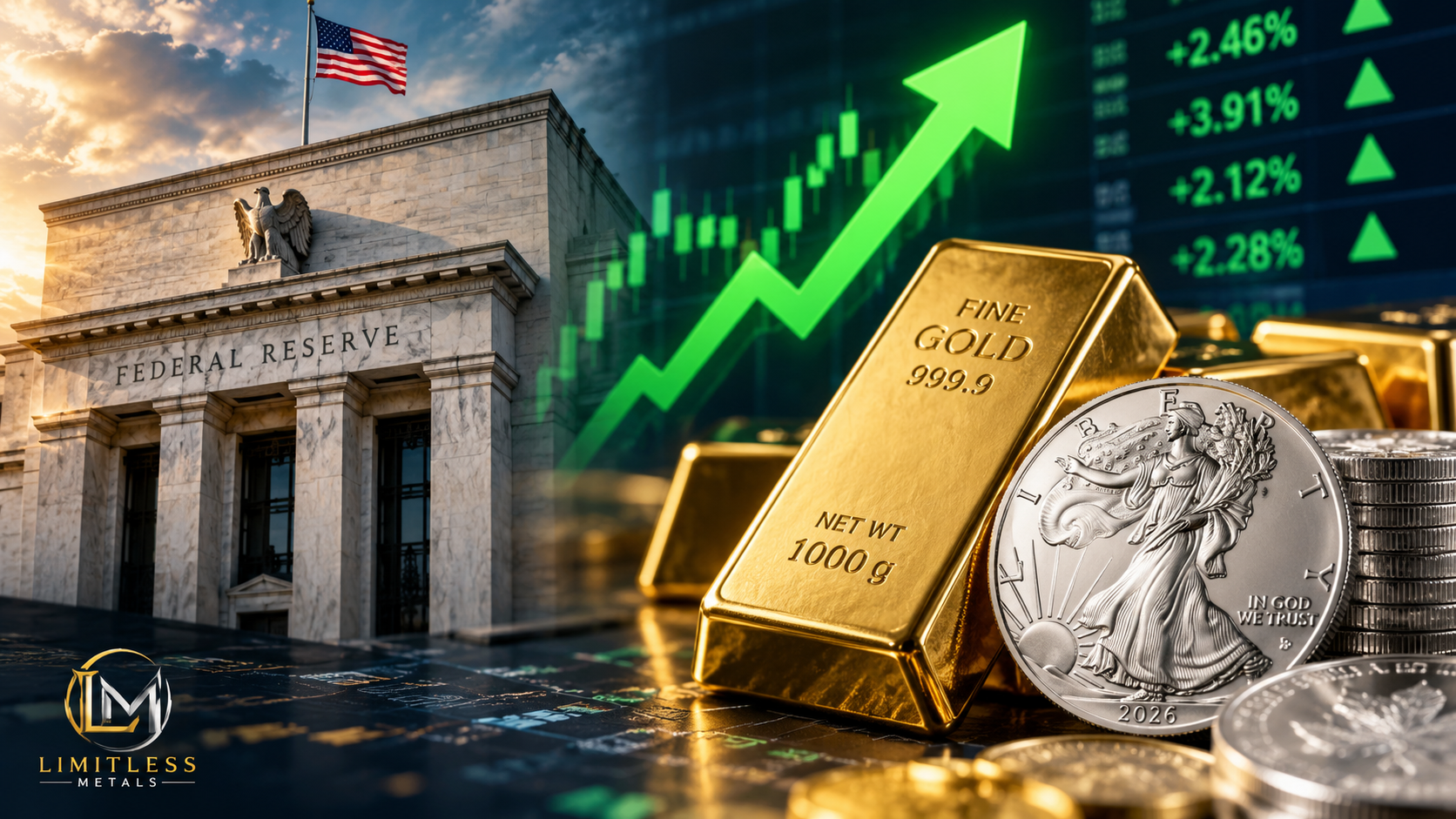
Spot gold climbed approximately 2.4% to $4,364 per ounce, while silver advanced roughly 3.9% to $65.44 per ounce during Thursday trading. Platinum and palladium also participated in the move, gaining about 2.1% and 2.2%, respectively.
The rally came less than 24 hours after the Federal Reserve raised its benchmark interest-rate range by 25 basis points to 3.75%–4.00%, its first rate increase in more than three years. The Federal Open Market Committee approved the move unanimously, saying economic activity continues to expand at a solid pace while inflation remains elevated.
For precious-metals investors, however, Thursday’s price action demonstrated that the relationship between interest rates and gold remains more complicated than simply “rates up, gold down.”
Gold Rebounds Despite Higher Interest Rates
Higher interest rates can create a headwind for gold because bullion does not pay interest. When Treasury securities and other interest-bearing assets offer higher yields, investors may have greater incentive to hold those assets instead.
That pressure was visible immediately following Wednesday’s Federal Reserve decision.
But by Thursday, several important market forces had shifted in gold’s favor.
Oil prices fell sharply, the U.S. dollar weakened from a seven-week high, and the benchmark 10-year Treasury yield moved lower. Together, those developments helped reduce some of the pressure that had weighed on precious metals following the Fed announcement.
A weaker dollar can be supportive for gold because precious metals are generally priced in U.S. dollars. When the dollar falls, gold becomes less expensive for buyers using other currencies.
Falling Treasury yields can also make non-yielding assets such as gold comparatively more attractive.
Oil Drops Back Toward $100
Energy markets were another major factor Thursday.
Brent crude fell roughly 3% to around $101.98 per barrel, while West Texas Intermediate declined to approximately $99.43 as concerns about immediate Middle Eastern supply disruptions eased.
That matters for precious metals because energy prices have become an important part of the inflation outlook.
Higher oil prices can increase transportation, manufacturing and consumer costs throughout the economy. Persistent energy inflation can encourage the Federal Reserve to maintain tighter monetary policy for longer.
A retreat in crude prices therefore removes at least some near-term inflation pressure.
For gold, Thursday’s combination was notable: oil moved lower, longer-term Treasury yields softened and the dollar gave back some of its post-Fed strength.
Silver Outpaces Gold
Silver’s approximately 3.9% gain was even stronger than gold’s move Thursday.
Silver frequently experiences larger percentage moves than gold because its market is smaller and it carries both monetary and industrial characteristics.
Investors therefore tend to watch silver not only as a precious metal but also for clues about manufacturing demand, industrial activity and broader commodity sentiment.
With silver trading above $65 per ounce Thursday, volatility remains elevated.
That can create significant price movement in both directions, particularly when markets are reacting simultaneously to Federal Reserve policy, Treasury yields, energy prices, currency movements and geopolitical developments.
What the Federal Reserve Said
The Federal Reserve’s September decision raised the federal funds target range to 3.75%–4.00%.
In its official statement, the Fed said economic activity was expanding at a solid pace, domestic spending remained resilient and inflation remained above the central bank’s long-term target.
The central bank also released updated economic projections following the September 15–16 meeting.
Markets are now focused on whether another rate increase could arrive at the Fed’s next meeting on October 27–28, 2026.
Reuters reported Thursday that futures markets were pricing roughly a 51% probability of another rate increase in October, up from about 44% the previous day.
That means the interest-rate outlook remains a major source of uncertainty for precious metals.
What Could Move Gold and Silver Next?
Several factors could determine whether Thursday’s rebound continues.
Treasury yields remain one of the most important indicators. A sustained move higher in yields could pressure gold, while falling yields could provide support.
The U.S. dollar will also be closely watched. Continued dollar weakness would generally make gold and silver more affordable for international buyers.
Oil and inflation expectations are another key factor. Crude oil remains above $100 per barrel despite Thursday’s decline, meaning energy markets could quickly return as an inflation concern if supply risks intensify.
Federal Reserve expectations may create additional volatility. Markets are now trying to determine whether September’s rate hike represents the beginning of a longer tightening cycle or a more limited response to persistent inflation.
And finally, physical and institutional demand remains important. Gold’s ability to rebound even after a rate increase illustrates that investors are weighing more than U.S. interest rates alone.
The Bigger Picture for Precious Metals
Thursday’s rally does not eliminate the risks facing gold and silver.
Higher interest rates can remain challenging for precious metals, and another shift higher in Treasury yields or the dollar could quickly change market conditions.
But the rebound highlights an increasingly complex environment.
Investors are balancing persistent inflation, Federal Reserve tightening, elevated government debt, geopolitical uncertainty, energy-market volatility and changing currency expectations—all at the same time.
Gold’s move back above $4,300 and silver’s advance above $65 demonstrate how quickly sentiment can change when several of those forces move together.
For investors considering physical precious metals, periods of volatility can be a useful reminder to focus on long-term objectives rather than attempting to predict every daily price move.
Limitless Metals provides access to physical gold and silver products as well as educational resources for investors researching precious metals and precious-metals IRAs.
Learn more about physical precious metals and retirement options at LimitlessMetals.com.
Precious metals involve risk and may appreciate, depreciate or remain unchanged. Past performance does not guarantee future results. Limitless Metals does not provide legal, tax or investment advice.
Sources:
Reuters — Gold gains over 2% on weaker dollar, easing oil prices
Reuters gold market reportReuters — Oil falls 3% as supply disruption fears ease
Reuters oil market reportFederal Reserve — September 16, 2026 FOMC Statement
Federal Reserve FOMC statementFederal Reserve — September 2026 Summary of Economic Projections
Fed economic projectionsFederal Reserve — FOMC Calendar
Stay Informed on Gold, Silver & Retirement Markets
Get market updates, precious-metals education, Gold IRA insights, and retirement-focused articles from Limitless Metals.